Lith Corporation, founded in 1998 by a group of material science doctor from Tsinghua University, has now become the leading manufacturer of battery lab&production equipment. Lith Corporation have production factories in shenzhen and xiamen of China.This allows for the possibility of providing high quality and low-cost precision machines for lab&production equipment,including: roller press, film coater,mixer, high-temperature furnace, glove box,and complete set of equipment for research of rechargeable battery materials. Simple to operate, low cost and commitment to our customers is our priority.
Microwave Pyrolysis Furnace: A Comprehensive Technical Introduction
A Microwave pyrolysis furnace is an advanced thermal-processing system designed to decompose organic and carbon-based materials using microwave energy under controlled, oxygen-limited conditions. Unlike conventional heating systems that rely on external heat transfer, microwave pyrolysis utilizes volumetric heating, allowing the material to absorb microwave energy directly. This mechanism enables rapid, uniform, and energy-efficient decomposition of feedstock, making the technology increasingly valuable in research laboratories and industrial environments focused on waste valorization, carbon-material synthesis, energy recovery, and environmental engineering.
1. Overview
The microwave pyrolysis furnace represents a new generation of pyrolytic equipment that integrates microwave heating technology, programmable temperature control, inert-gas regulation, and advanced safety mechanisms. Its primary function is to convert raw materials—such as biomass, polymers, wastes, and carbon precursors—into high-value products like biochar, syngas, activated carbon, nanocarbon materials, and specialty chemical compounds. Due to its high heating efficiency and reaction controllability, the equipment is widely adopted in renewable-energy research, circular-economy projects, chemical engineering studies, and next-generation materials development.
2. Key Features
A modern microwave pyrolysis furnace typically incorporates several technical features:
• Microwave Heating System
High-power magnetrons (commonly 1 kW–6 kW) generate microwaves in the 2.45 GHz range, enabling fast and uniform energy penetration into the sample.
• Precise Temperature Control
Advanced PID-based controllers enable accurate heating profiles up to 1000°C or more, ensuring stable thermal decomposition for sensitive materials.
• Oxygen-Limited Reaction Chamber
A sealed quartz or ceramic reaction tube allows inert-gas operation with nitrogen, argon, or other non-oxidizing atmospheres, ensuring controlled pyrolytic conditions.
• Programmable Operating Modes
Users can customize heating rates, dwell times, ramp sequences, and gas-flow programs suitable for a wide range of experimental requirements.
• Real-Time Monitoring and Safety Systems
Thermocouples, infrared sensors, pressure-release mechanisms, and microwave leakage detectors ensure safe operation during high-temperature and volatile-gas processes.
3. Working Process
The pyrolysis process inside a microwave furnace follows a systematic sequence:
1. Preparation and Loading – Raw materials, such as biomass, plastic waste, polymer precursors, or carbon feedstock, are placed in a microwave-susceptible container (e.g., silicon carbide crucible) to enhance energy absorption.
2. Atmosphere Control – The chamber is purged with inert gas to eliminate oxygen, preventing unwanted combustion reactions.
3. Microwave Heating – Microwaves interact with the feedstock’s molecular structure, generating internal heat uniformly and rapidly. Heating rates can range from 10°C/min to over 100°C/min depending on material composition.
4. Pyrolysis Reaction – As temperature increases, chemical bonds inside the sample break down, producing biochar, carbon residue, oil vapors, and gases such as CO, H₂, and CH₄.
5. Product Collection – Solid pyrolysis products remain in the crucible, while volatile compounds are condensed or captured using an external gas-collection system.
6. Cooling and Discharge – The system cools under inert conditions before the final product is removed and analyzed.
This highly controllable process is ideal for both small-scale laboratory research and pilot-scale material innovation.
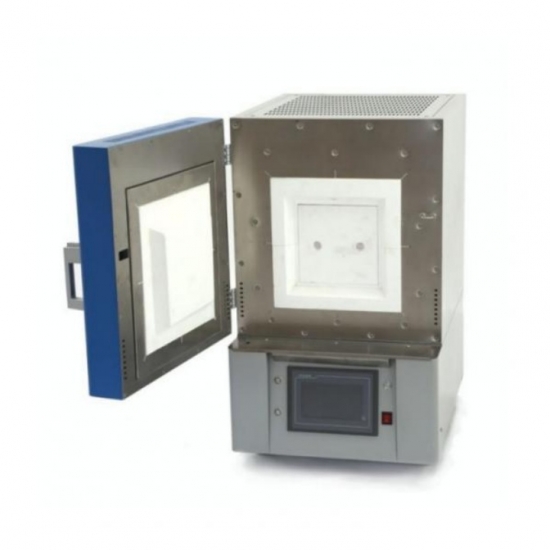
Electric Atmosphere Furnace
4. Applications
Microwave pyrolysis furnaces are widely used across scientific and industrial fields:
• Biomass Conversion
Production of biochar, bio-oil, and renewable syngas from agricultural waste, wood, or algae.
• Polymer and Plastic Recycling
Processing waste plastics into recoverable hydrocarbon oils and gas fuels, contributing to circular-economy initiatives.
• Carbon-Material Synthesis
Fabrication of activated carbon, carbon nanotubes, graphene-like materials, and porous carbon structures with enhanced adsorption properties.
• Battery and Energy-Material Development
Preparation of electrode materials, carbon precursors, and functional powders used in lithium-ion, sodium-ion, and solid-state batteries.
• Environmental Engineering
Treatment of sewage sludge, hazardous materials, and industrial residues through controlled thermal decomposition.
5. Advantages
The microwave pyrolysis furnace offers several significant advantages over traditional thermal systems:
• Rapid and Uniform Heating
Microwaves generate internal energy directly in the material, drastically reducing processing time and improving uniformity.
• High Energy Efficiency
Volumetric heating minimizes energy loss, making microwave pyrolysis more efficient than resistance or convection furnaces.
• Lower Reaction Temperatures
Microwave-assisted processes often achieve similar decomposition results at lower temperatures due to enhanced molecular vibration effects.
• Enhanced Product Quality
The precise and controllable environment improves the structural properties of carbon materials and increases the yield of valuable pyrolysis products.
• Flexible and Scalable
Suitable for laboratory experiments, pilot projects, and industrial-scale production.
• Improved Safety and Environmental Performance
Oxygen-isolated environments and reduced emissions support cleaner and safer thermal-processing operations.
 English ▼
 Subscribe to us
 ONLINE
 +86 13174506016
 Louis@lithmachine.com
 +86 18559646958
 18659217588


